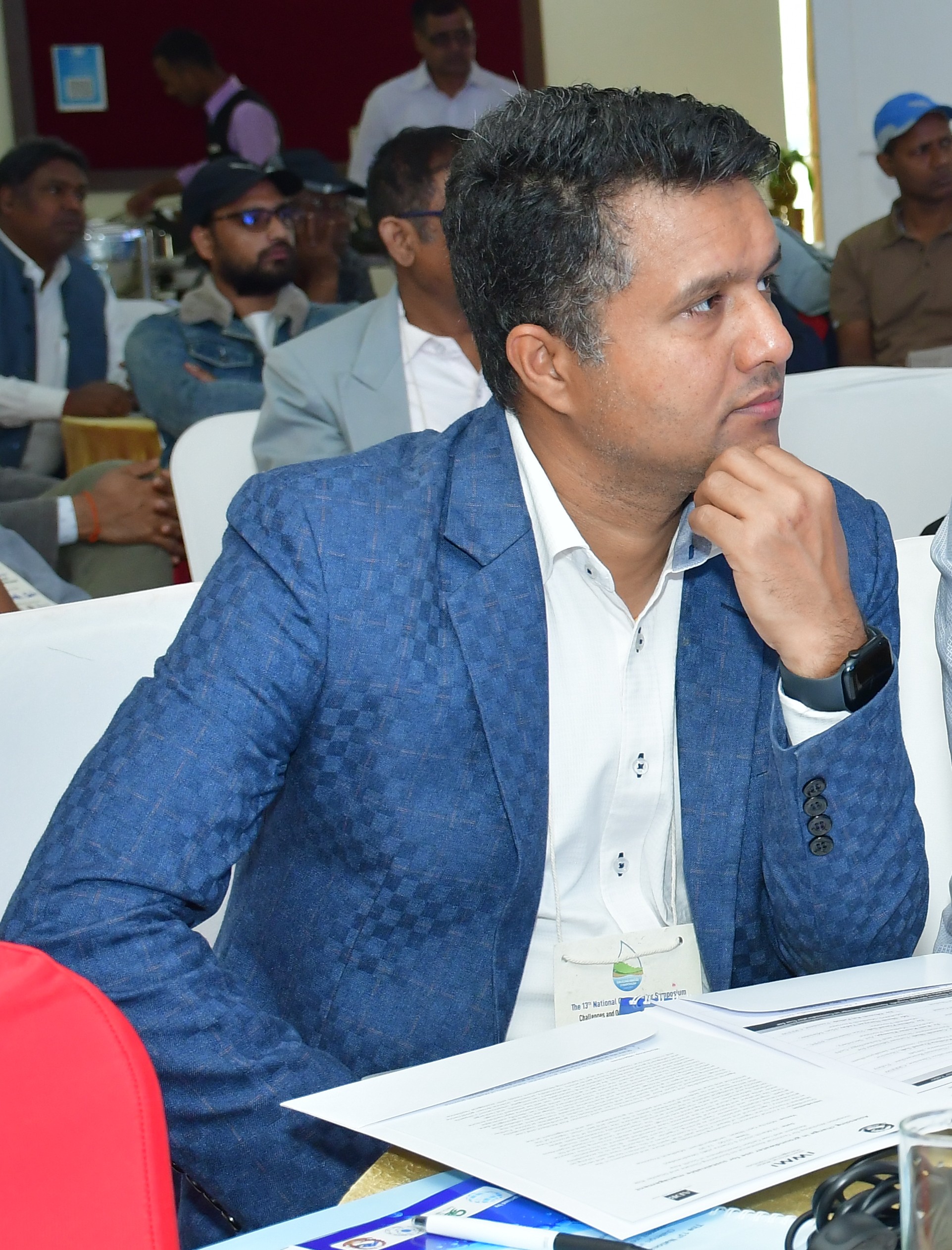
About Me
I am Dr. Anil Aryal, working as Executive Director at the Center of Research for Environment Energy and Water (CREEW). Previously, I worked as a National Researcher in Water Resource Management at the International Water Management Institute (IWMI). I am a hydrologist by profession and academics.
I have worked in a multi-cultural environment and multiple countries since 2010. I did my PhD in Integrated Water Resource Management from the University of Yamanashi (UY), Yamanashi Prefecture, Japan (2016–2019) and Master's degree in Water Engineering and Management
from the Asian Institute of Technology (AIT), Thailand (2014–2016). I have more than 15 years of working experience in the field of water resources and climate change in Nepal, Japan, Thailand, and many other countries.
In the past, I worked as a postdoc researcher at the University of Yamanashi from 2019 to 2022 and as a Senior Research Specialist at the Asian Institute of Technology from 2022 to 2023. Before that, I worked as a Civil Engineer and Lecturer for various other positions and organizations in Nepal.
I completed a Bachelor degree in Civil Engineering from Nepal Engineering College (nec), Pokhara University (2006–2010).
Research Interests
- Water Resource Management
- Climate Change Studies
- Hydrological/Numerical Modeling
- Remote Sensing
- Groundwater Management
- Water Sanitation and Hygiene
- Socio Hydrology
Skills
- Hydrological Models: SWAT, HEC-HMS, UY-BTOPMC, Visual MODFLOW
- Programming: R, Python, HTML, CSS
- GIS: ArcGIS, QGIS
- Office: MS Word, Excel, PowerPoint
- Open-source: LaTeX, UNIX, LINUX
Water Energy Food Nexus
My research on the Water-Energy-Food (WEF) nexus investigates the interconnections among these sectors under climate change, mainly in river basins of Nepal and Myanmar. I employ integrated modeling tools to assess resource demands, trade-offs, and future scenarios for more holistic policy guidance.
A major study in the Sittaung River Basin in Myanmar used the WEAP model with satellite data and multiple climate projections. Results showed future increases in temperature and rainfall, leading to higher river flows that benefit domestic water supply and hydropower generation. However, agricultural water demand rose significantly due to increased evapotranspiration, resulting in larger unmet demands for food production during dry periods. This work clearly illustrates the asymmetric impacts of climate change across nexus sectors.
Many of my other studies on water resources and climate indirectly support WEF nexus understanding by linking hydrology to irrigation needs, hydropower potential, and land-use dynamics. Streamflow analyses inform multi-purpose reservoir planning, while drought and soil moisture research help address agricultural vulnerabilities.
My WEF nexus outcomes provide scenario-based evidence for managing trade-offs between sectors. The quantitative projections help prioritize investments in water storage, efficient irrigation technologies, and diversified energy sources. These findings are particularly relevant for climate-vulnerable river basins in developing regions and support cross-sectoral coordination for sustainable and equitable resource management.
Climate Change
My research on climate change examines its impacts in Nepal and Myanmar through downscaled global climate model projections, hydrological modeling, and observational data. I focus on understanding shifts in temperature and precipitation, extreme events, and vulnerabilities across river basins, urban areas, and agricultural zones, particularly in topographically complex and data-scarce environments.
In the Tamakoshi River Basin study, I projected significant warming trends and modest changes in precipitation patterns under different scenarios. Discharge projections varied widely, and detailed uncertainty analysis helped separate the contributions of different modeling components. This work stressed the value of multi-model ensembles for more robust future projections in mountain regions.
I have analyzed extreme precipitation indices in the West Rapti Basin, showing intensification of extreme events that increase flood and erosion risks. My drought characterization studies across Nepal revealed increasing frequency and severity, with clearer patterns in eastern parts of the country. Streamflow alteration research indicated annual discharge reductions along with changes in timing and extremes, affecting hydropower, irrigation, and ecosystems.
In the Sittaung River Basin in Myanmar, I used an integrated modeling approach to project future temperature and rainfall increases, with drier non-monsoon periods and wetter rainy seasons. River flows were expected to rise, benefiting domestic water supply and hydropower generation, but agricultural water demands increased due to higher evapotranspiration, creating sectoral imbalances.
I have also investigated urban heat islands in major South Asian cities including Kathmandu Valley, Delhi, and Dhaka using satellite data. These studies showed rising land surface temperatures in built-up areas, driven by loss of vegetation and increase in impervious surfaces. Other contributions explore climate impacts on water availability, pollution-economy linkages, rainfall erosivity trends, and the cooling potential of blue-green infrastructure in urban settings.
My climate change research consistently demonstrates warming trends, shifting precipitation regimes, and intensified extremes that create both risks and sectoral trade-offs. The quantitative insights from my work support improved risk mapping, adaptation planning, and policy development for climate-resilient infrastructure and nature-based solutions in the Hindu Kush-Himalaya region.
Water Resources
My research in water resources primarily focuses on the Himalayan and South Asian river basins, with particular emphasis on Nepal’s hydrological systems. I integrate hydrological modeling, climate projections, satellite data, and field observations to evaluate water availability, streamflow dynamics, flood and drought risks, soil moisture, and sustainable management strategies in data-scarce mountainous environments. Through collaborations with institutions such as the International Water Management Institute (IWMI) and the Asian Institute of Technology, I have worked to understand how precipitation variability, land-use changes, and human activities influence water resources in transboundary and urban watersheds.
One of my key contributions involves quantifying uncertainty in hydrological climate-impact projections for the Tamakoshi River Basin in eastern Nepal. Using multiple climate models under different scenarios combined with SWAT and HEC-HMS hydrological models, I projected notable temperature increases and slight decreases in precipitation. The discharge projections showed considerable variation depending on the model used, with statistical analysis (ANOVA) revealing that climate model choice has the strongest influence on wet-day uncertainty, while hydrological model selection dominates on dry days. This work highlighted the importance of using ensemble approaches and bias correction in data-limited basins to improve reliability for flood and drought preparedness.
I also conducted a detailed analysis of precipitation elasticity in the West Rapti River Basin. By comparing ground gauge data with satellite-based precipitation estimates and applying bias correction, I found that IMERG performed best after correction. The precipitation elasticity was calculated at approximately 1.5, indicating that a 1% change in precipitation leads to about a 1.5% change in discharge. This was the first such study in a Nepalese basin and demonstrated the practical value of satellite precipitation products for hydrological modeling in remote Himalayan areas.
In another study, I examined streamflow variability across major and medium rivers in Nepal using Indicators of Hydrologic Alteration. My analysis revealed moderate declines in mean annual discharge and shifts in extreme flows, with overall hydrologic alteration falling in the low-to-medium range. This suggests that river ecosystems still maintain some resilience but face growing vulnerability to additional climate and human pressures.
I have also characterized meteorological droughts across Nepal by comparing different indices, finding higher spatial severity in eastern regions. Additional work includes flood susceptibility mapping in the Kathmandu Valley Watershed, rainfall erosivity assessment for soil loss estimation, land surface temperature analysis, soil moisture distribution mapping, and climate impact evaluations on water availability in various districts.
Overall, my research in this sector emphasizes integrated and uncertainty-aware modeling for Himalayan water resources. It highlights increasing flood risks during wet seasons alongside dry-season shortages, the usefulness of combining ground and satellite data, and the need for proactive adaptation strategies. These findings support better policy decisions for reservoir operations, irrigation planning, transboundary cooperation, and achieving water-related sustainable development goals in Nepal and similar regions.
Remote Sensing
I extensively use remote sensing techniques to monitor land surface temperature, urban heat islands, precipitation, soil moisture, and land-use changes across South Asia. This approach helps overcome limitations of sparse ground observation networks in Nepal and neighboring countries. I commonly work with Landsat, MODIS, and various satellite precipitation products, integrating them with GIS and hydrological models.
In my urban heat island research across South Asian cities, I derived land surface temperature from Landsat imagery and identified clear heat island effects in densely built central areas of Kathmandu Valley, Delhi, and Dhaka. Strong negative correlations between vegetation indices and temperature, along with positive correlations with built-up indices, confirmed urbanization as the primary driver. These findings support the use of remote sensing for regular urban climate monitoring and heat mitigation planning.
I have evaluated the performance of different satellite precipitation estimates against ground data in Nepalese basins, identifying suitable products and correction methods for improved hydrological simulations in ungauged areas. My work on soil moisture index mapping provides spatial insights valuable for agricultural planning and drought monitoring. I have also applied remote sensing data for flood susceptibility mapping in the Kathmandu Valley Watershed and for assessing the cooling effects of urban green and blue spaces.
My remote sensing contributions deliver high-resolution spatial information where traditional monitoring is limited. Methodological improvements in bias correction and index derivation enhance accuracy and reproducibility. These outcomes offer practical tools for urban planners, agricultural services, disaster management agencies, and water resource professionals working in data-scarce mountainous and urban environments.